
Two minutes. One shot. Nowhere to plug in.
The Iceland Space Agency needed a live broadcast off a rooftop on the Snæfellsnes peninsula, into a window that lasted two minutes and seven seconds and was never going to happen twice. Reuters was waiting on the feed. There was no fibre, no rack room and no mains power within reach.
We built the uplink. It ran 48 minutes without dropping once.
A deadline that could not move.
Most networks are graded on averages — uptime across a month, throughput on a good day. This one was graded on two minutes and seven seconds, on a peninsula in the North Atlantic, in front of a wire service.
The Iceland Space Agency brought the telescopes and cameras. Snæfellsjökull National Park and the Nature Conservation Agency of Iceland brought the site. Our job was the layer between that rooftop and everyone waiting on the other end of it — with nothing to plug into and no possibility of trying again next week.
Two paths, twenty feet apart, carrying identical packets.
Two Starlink Minis, both in Global Roam on the priority service, set twenty feet apart so that no single obstruction — or passing squall — could sit on both dishes at once.
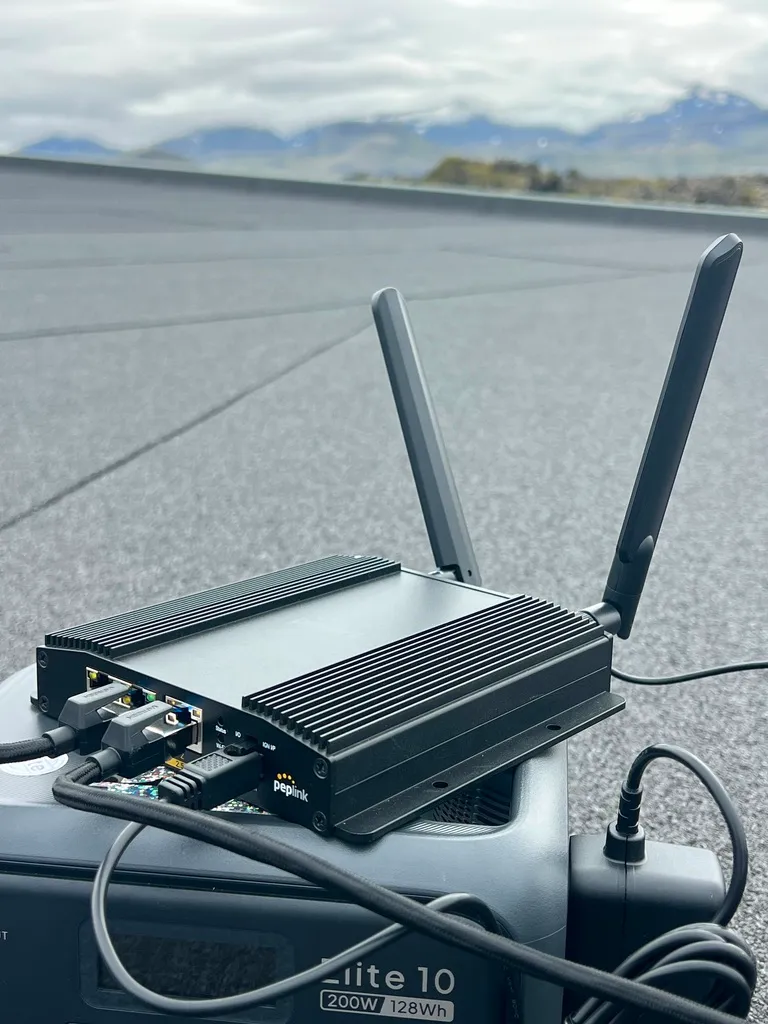
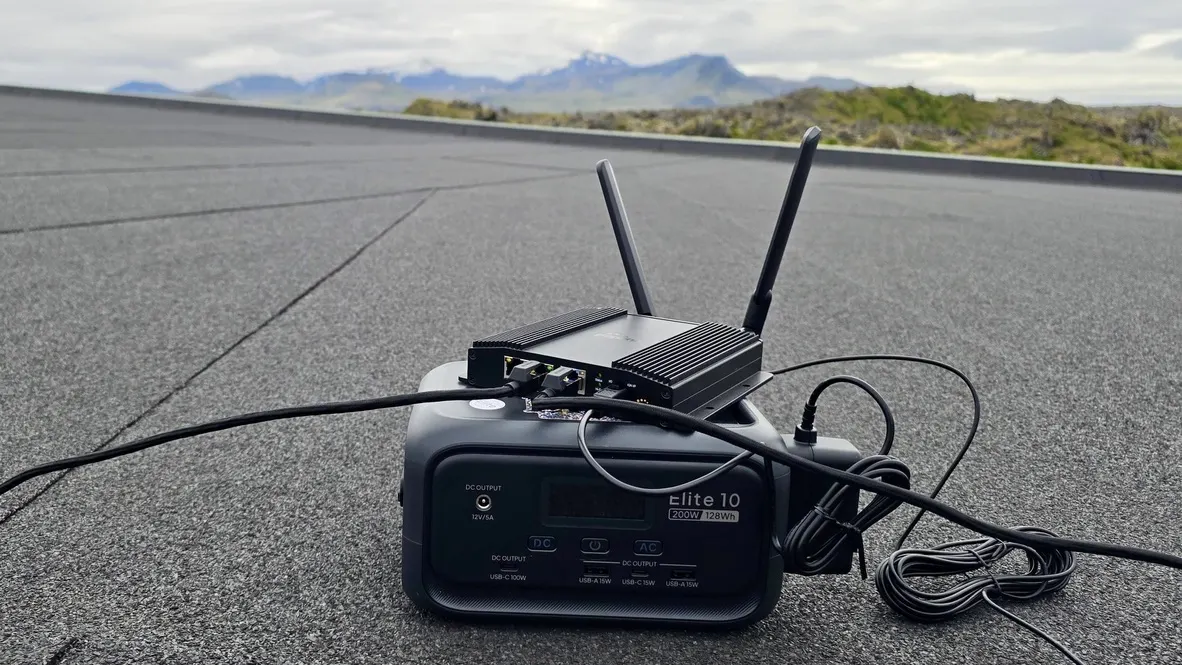
Both fed a Peplink MAX Orbit 2 — a router built specifically to bond multiple satellite terminals — running WAN smoothing, and that is the part that actually matters. Failover means noticing a path has died and moving to another one; the noticing is the bit your viewers see. WAN smoothing doesn’t wait. It sends the same packets down both paths simultaneously, so when one degrades the duplicate has already arrived. There is nothing to switch to and nothing to sit through.
The whole assembly ran off a portable battery, on a roof, in the wind, for the duration. Two Minis, a router and a battery is a kit that travels as luggage — which is the point. Nothing here was bespoke to Iceland, and nothing here needs a building to be useful.
Two satellite paths
Two Starlink Minis in Global Roam, priority service, physically separated so weather and obstructions can’t take both.
Duplication, not failover
WAN smoothing on the Peplink sends identical packets down both links, so a degraded path never becomes a visible event.
Battery, not infrastructure
Portable power for the full run. Nothing in the chain depended on the building we were standing on.
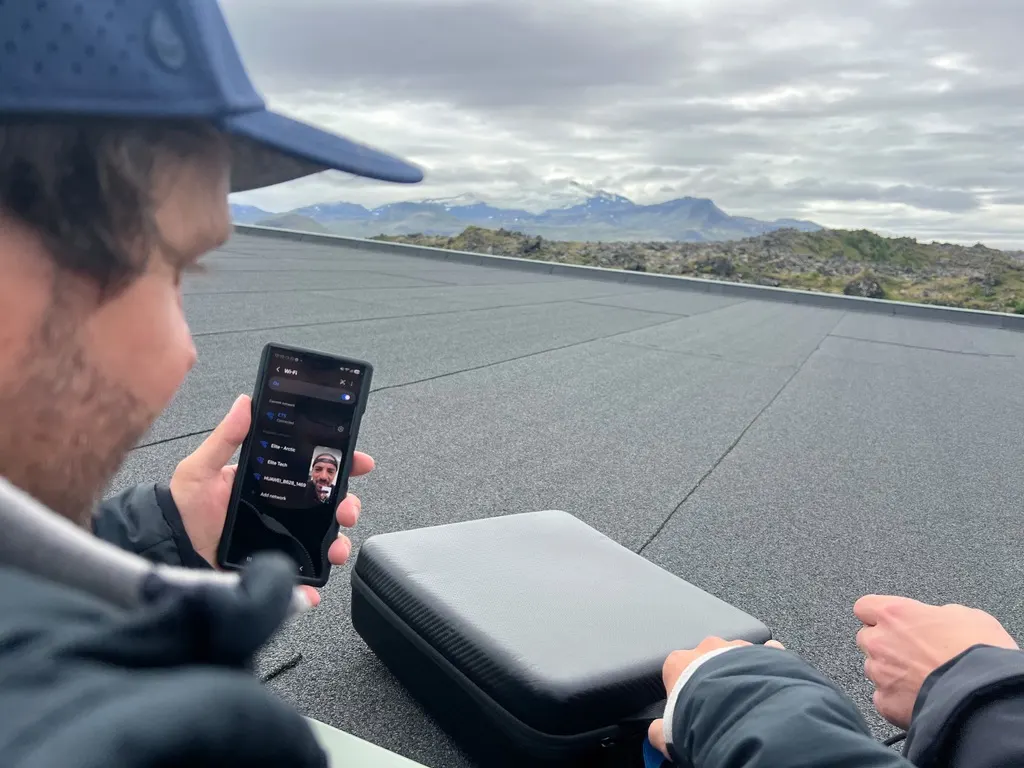
Forty-eight minutes of frames that arrived.
Then the weather did what weather does. Rain pushed the telescopes under cover; they came off in time, and the cloud never moved. A solar filter dense enough to be aimed at the sun shows nothing at all without direct sunlight, so there was no picture to send — and Reuters, reasonably, never ran it.
The network never went down. The video feed never went up.
Which makes the recording below a stranger and better piece of evidence than a clean eclipse would have been. A corona on screen would have made the uplink invisible — nobody thinks about transport while they’re looking at the sun. What actually exists is 48 unbroken minutes with exactly one variable in shot: whether the link held. It did, continuously, from a battery on a roof in the North Atlantic.
You don’t have to take our word for any of it. The recording isn’t hosted by us — it sits on the official Vimeo channel of the Nature Conservation Agency of Iceland, one of the four organisations on that frame, with our logo on screen for all 48 minutes.
The same sky, twice.
The cloud that blinded the telescope was transparent to the radios.
Both instruments were pointed at the same piece of sky. Visible light could not cross that cloud layer; at radio wavelengths it may as well not have been there. The telescope had one route to the sun and the weather closed it. Our signal had two routes to the satellites, and the weather was never in a position to touch either.
Redundancy is half the answer. The other half is choosing paths that the threat you actually face cannot reach. That is the entire design brief for a network that doesn’t go down, and Iceland is simply the harshest place we’ve had to prove it.
Your building has both kinds of path. The connection your business runs on, the power behind it, the systems your people can’t work without — every one of them can be given a second route. Most never have been.
Explore Never Down